
Why White Light Is Ruining Your Baby’s Sleep (And What to Use Instead)
White light disrupts your baby’s sleep hormones. Learn the science behind melatonin, safe night light colors, and how to protect infant sleep biology.
By Emily Harper Baby gift expert specializing in child development research, evidence-based parenting resources, and infant product safety documentation.
2/10/20265 min read
Summary:
White and blue light suppress melatonin in infants, delaying sleep and disrupting circadian development
Babies are biologically more sensitive to light than adults due to immature sleep regulation systems
Red light has the least impact on infant sleep hormones during nighttime care
“Dim” white light can still interfere with sleep biology
Mimicking natural sunset light cycles supports healthier infant sleep patterns
Understanding the Biology of Baby Sleep and Light Exposure
If your baby struggles to fall back asleep after night feeds, the problem may not be hunger, routine, or temperament — it may be light.
Modern nurseries are often filled with “soft,” “warm,” or “dim” lighting that feels harmless. But from a biological standpoint, many of these lights send powerful wake-up signals directly to an infant’s developing brain.
Unlike adults, babies are still building the neurological systems that regulate sleep, hormones, and circadian rhythm. Light is one of the strongest environmental signals guiding that development.
In this guide, you’ll learn:
Why white light is uniquely disruptive to infant sleep biology
How melatonin works differently in babies than adults
Why red and amber light behave differently in the brain
How to avoid common nursery lighting mistakes
What pediatric sleep science actually recommends
This isn’t about parenting style — it’s about biology.
Table of Contents
The Science of Melatonin and the Infant Brain
How Blue and White Light Suppress Sleep Hormones
The “Sunset Effect”: Why Natural Light Cycles Matter
Red Light vs. Amber Light: Which Is Better for 2 AM Feeds?
Why Red Light Has the Least Impact on Sleep Inertia
When Amber Light May Be a Better Choice
Common Mistakes Parents Make With “Dim” Lighting
Why Brightness Matters Less Than Wavelength
Hidden White-Light Sources Sabotaging Sleep
Designing a Biologically Supportive Nursery Lighting Setup
Ideal Nighttime Lighting Rules
Transitioning From Day to Night the Right Way
The Science of Melatonin and the Infant Brain
How Blue and White Light Suppress Sleep Hormones
Melatonin is the hormone that signals sleep. In adults, it rises gradually in the evening and falls in the morning. In infants, this system is still under construction.
Specialized cells in the retina called intrinsically photosensitive retinal ganglion cells (ipRGCs) detect light — especially blue wavelengths — and send signals directly to the brain’s circadian control center, the suprachiasmatic nucleus [1].
White light contains a large blue wavelength component, even when it appears warm or dim. When these wavelengths hit an infant’s eyes at night:
Melatonin production is suppressed
The brain interprets the environment as “daytime”
Sleep onset is delayed or fragmented
Infants are more vulnerable because:
Their pupils let in more light
Their circadian rhythm is immature
Their melatonin response is exaggerated compared to adults [2]
This is why a quick diaper change under white light can fully wake a baby who was previously drowsy.
The “Sunset Effect”: Why Natural Light Cycles Matter
Human biology evolved under predictable light transitions — bright days, gradually dimming evenings, and true darkness at night.
This gradual reduction in light intensity and wavelength (from blue → amber → red → darkness) is known as the sunset effect.
Artificial lighting disrupts this process by:
Maintaining blue-rich light after sunset
Eliminating contrast between day and night
Confusing circadian entrainment during infancy
Research shows that consistent exposure to inappropriate nighttime light can delay circadian rhythm development in infants [3].
In simple terms:
Your baby’s brain needs darkness — or near-darkness — to learn when night happens.
Red Light vs. Amber Light: Which Is Better for 2 AM Feeds?
Why Red Light Has the Least Impact on Sleep Inertia
Red light sits at the far end of the visible spectrum and barely activates ipRGC cells.
That means:
Minimal melatonin suppression
Reduced sleep inertia (the groggy, half-awake state that helps babies fall back asleep)
Less disruption to circadian signaling
Studies consistently show red light has the lowest biological impact on sleep hormones compared to white, blue, or even amber light [4].
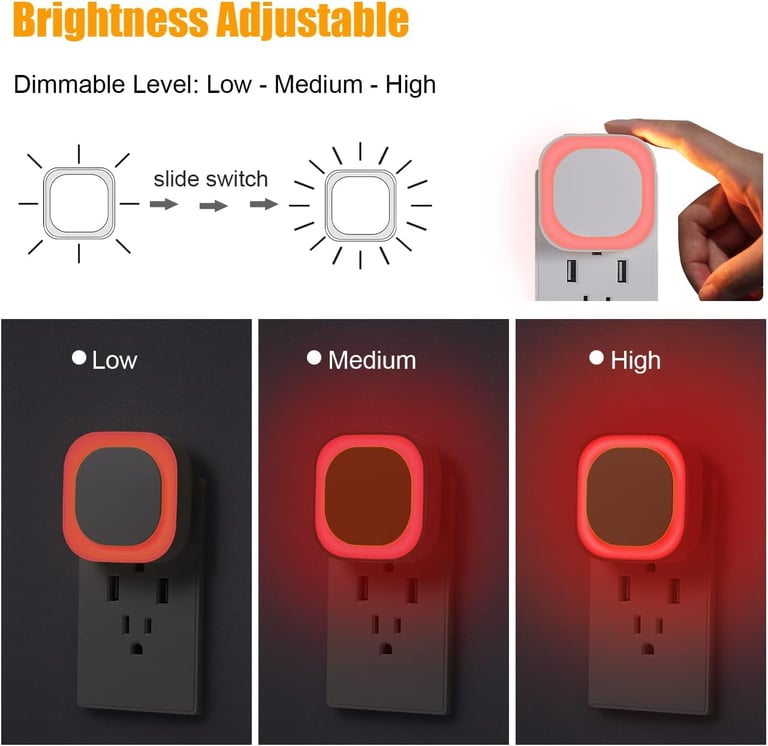
For overnight feeds, diaper changes, and soothing, red light is the gold standard.
When Amber Light May Be a Better Choice
Amber light occupies a middle ground. It contains less blue light than white bulbs but more than red.
Amber lighting can be useful when:
Parents need slightly better visibility
Safety concerns outweigh sleep optimization
Red light feels too dark or disorienting
While amber is not as biologically “silent” as red, it is vastly superior to white light and far less disruptive to infant sleep patterns.
Common Mistakes Parents Make With “Dim” Lighting
Why Brightness Matters Less Than Wavelength
One of the biggest misconceptions is that dim light equals safe light.
In reality:
Wavelength matters more than brightness
Dim white light can suppress melatonin more than bright red light
This is why “soft white,” “warm glow,” and “low lumen” bulbs can still disrupt sleep if they emit blue wavelengths [5].
Marketing language does not equal biological safety.
Hidden White-Light Sources Sabotaging Sleep
Many nurseries contain unintended light sources, including:
Phone flashlights during feeds
Baby monitors with white LEDs
Hallway or bathroom lights spilling into the room
Appliances with indicator lights
Even brief exposure can be enough to disrupt melatonin signaling in sensitive infants.

Designing a Biologically Supportive Nursery Lighting Setup
Ideal Nighttime Lighting Rules
For overnight care:
Use red or true amber light only
Keep light intensity as low as safely possible
Position lights below eye level
Avoid overhead lighting entirely
For daytime:
Maximize natural daylight exposure
Keep naps bright to reinforce day/night contrast
This contrast strengthens circadian entrainment over time.
Transitioning From Day to Night the Right Way
About 60–90 minutes before bedtime:
Dim household lights gradually
Eliminate blue-rich screens
Shift to amber or red lighting
This predictable transition teaches your baby’s brain that sleep is approaching — even before melatonin production fully matures.
What Pediatric Sleep Science Actually Recommends
Pediatric sleep researchers broadly agree:
Darkness supports healthy sleep hormone regulation
Blue-rich light delays sleep onset
Consistent light-dark patterns improve infant sleep consolidation
Organizations such as the American Academy of Pediatrics and NIH-supported sleep research emphasize minimizing artificial light exposure during nighttime hours for infants [1][2].

Frequently Asked Questions
Is white light ever safe for babies at night?
White light is best avoided during nighttime care. Even dim white light can suppress melatonin and disrupt infant sleep biology.
What color night light helps babies sleep best?
Red light has the least impact on sleep hormones, followed by amber. Both are significantly better than white or blue light.
Does dim light still affect melatonin production?
Yes. Wavelength matters more than brightness. Dim white light can still interfere with sleep hormones.
Can night lights cause long-term sleep problems?
Chronic nighttime light exposure may delay circadian development, potentially affecting sleep consolidation over time.
Is red light safe for newborn eyes?
Yes. Red light is considered safe and is widely used in neonatal and pediatric care environments.
Final Thoughts: Protecting Your Baby’s Sleep Biology
Your baby’s sleep isn’t fragile — it’s developing.
Light is one of the most powerful environmental signals shaping that development, and small changes can have outsized effects. Choosing biologically appropriate lighting isn’t about perfection or aesthetics. It’s about aligning your home with how your baby’s brain actually works.
By minimizing white light at night and respecting natural light cycles, you’re not just improving sleep tonight — you’re supporting healthier circadian rhythms for years to come.
Sometimes, the simplest change makes the biggest difference.
Related Articles:
Baby Sleep Lighting Guide: Best Night Lights That Won’t Ruin Sleep
Essentials for Newborns: The Ultimate Gift Guide for New Parents
How to Create the Ultimate Baby Registry: A Step-by-Step Guide
Low-Light Sleep Lamps for Babies: Complete Guide
Practical Baby Gifts That Help New Parents Sleep Better
Top Baby Gifts That Grow with Your Child: Smart, Long-Lasting Picks
Citations and Sources:
American Academy of Pediatrics. Light Exposure and Circadian Health. https://publications.aap.org
National Institutes of Health. Circadian Rhythms and Melatonin. https://www.nigms.nih.gov
Rivkees SA. Developing Circadian Rhythms in Infants. PubMed. https://pubmed.ncbi.nlm.nih.gov
Harvard Health Publishing. Blue Light and Sleep. https://www.health.harvard.edu
Brainard GC et al. Action Spectrum for Melatonin Regulation. Journal of Neuroscience. https://www.jneurosci.org